


Low-temperature storage tank
Release time:
2022-01-20
Low-temperature storage tank
The low-temperature storage tank is a vertical or horizontal double-layer vacuum insulated storage tank used for storing liquid oxygen, nitrogen, argon, carbon dioxide, and other media. The inner container is made of austenitic stainless steel; the outer container material is selected according to national regulations as Q235-B, Q245R, or 345R, depending on the user's region, with the interlayer filled with insulating materials such as perlite or aluminum foil, and vacuumed.
Structure
Liquid natural gas must be stored in low-temperature storage tanks, which typically consist of an inner tank and an outer tank, with insulating material filled in between.
Inner tank
The inner tank, also known as a "membrane tank," is a liquid-tight and flexible container made of thin low-temperature steel plates. It must transmit the hydraulic head to the insulation layer. The material used for the membrane must have the property of not becoming brittle under low-temperature conditions and must have sufficient toughness and good processing performance. Nickel steel, stainless steel, or aluminum alloy is commonly used.
Insulation layer
The insulation layer not only transmits the hydraulic head to the outer tank but also reduces the amount of vaporization, minimizes the temperature difference between the inner and outer walls of the tank, and alleviates the thermal stress caused by this temperature difference. Additionally, it has the function of fixing the "membrane." Therefore, the insulation layer is required to have low thermal conductivity and sufficient strength. Materials that meet these conditions include rigid foam polyurethane, foam glass, perlite, and rigid foam phenolic resin. To improve the insulation performance and cost-effectiveness of the insulation materials, a mixed insulation method using powder, fiber, and board insulation materials can be employed.
After the liquefied natural gas is injected into the tank, the inner tank wall will contract due to the cold; conversely, after the liquefied natural gas is completely discharged, the temperature inside the tank will gradually rise, causing the inner tank wall to expand. The powdered insulation material filled between the inner and outer tanks becomes compact due to the repeated expansion and contraction of the inner tank wall. Therefore, a layer of highly elastic insulation must be laid close to the inner tank, with the thickness of this insulation layer adapted to the expansion and contraction of the inner tank wall, serving as a buffer during the expansion and contraction of the inner tank wall to ensure the safe operation of the storage tank.
Outer tank (also known as tank body)
The outer tank is the shell that can withstand various loads and must have sufficient strength. Depending on the materials used, it can be divided into the following types: frozen soil wall, steel wall, reinforced concrete wall, and prestressed concrete wall.
① Frozen soil wall. The frozen soil wall and the insulation cover form a gas-tight closed space as the outer tank, also known as a pit storage cavity. During construction, cooling pipes are used to freeze the soil surrounding the inner tank. After the pit storage cavity is put into production, the low-temperature liquid will keep the surrounding area in a frozen state, and this frozen soil layer will continue to expand year by year, thus reducing evaporation losses year by year. The prerequisite for constructing a pit storage cavity is to have a relatively high groundwater level, and the bottom of the pit storage cavity should be the least permeable rock or clay layer.
② Steel wall (including alloys and aluminum). It is only suitable for constructing above-ground low-temperature storage tanks. The above-ground low-temperature storage tank differs from general ambient temperature tanks, as it must consider the risk of damage to the tank due to soil freezing and expansion beneath the tank. Therefore, measures must be taken to prevent soil freezing, and above-ground storage tanks can generally be divided into ground-based and elevated types. The ground-based type uses perlite concrete insulation at the bottom, with hot air or hot water circulated through embedded pipes, or electric heaters pre-set inside the foundation to prevent soil freezing. The elevated type uses columns to support the tank chassis, keeping it separated from the ground and allowing air circulation between the tank and the ground to prevent liquefied natural gas from absorbing a large amount of heat from the ground, thus avoiding soil freezing.
③ Reinforced concrete wall and prestressed concrete wall. These two types of outer walls are the main materials for the underground tank shell and have the following advantages:
a. Reinforced concrete and prestressed concrete are excellent low-temperature materials; even if the membrane is damaged, contact between the low-temperature liquid and the prestressed concrete wall will not damage the outer wall.
b. Good durability, not subject to corrosion from groundwater, and does not become brittle.
c. It has good liquid tightness and relatively good seismic performance.
There is no unified standard for the design definition of low-temperature storage tanks. In contrast, the technical standards in the UK are relatively systematic and comprehensive. Their standard "Application of Flat-Bottom Vertical Cylindrical Low-Temperature Storage Tanks" defines low-temperature tanks as three types of tank forms: single-container tanks, double-container tanks, and full-container tanks, based on different process requirements and media storage methods. A single-container tank generally consists of a steel inner tank plus an insulating outer shell, while double-container tanks and full-container tanks consist of a steel inner tank and an outer tank made of steel or concrete (generally prestressed concrete), with insulation placed between the inner and outer tank walls, with the double-container form being the most common.
When designing low-temperature tanks, due to the conductive effect of the low-temperature medium inside the tank, the foundation soil is prone to freezing and swelling, causing the soil to uplift and potentially damaging the foundation. To eliminate this adverse factor, in addition to setting insulation measures between the tank bottom plate and the foundation bottom plate surface, frost prevention measures must also be taken for the tank foundation. There are generally two common practices: one is to use electric or other heating systems within the foundation bottom plate, creating a raft foundation with a circulating heating system; the other is to elevate the foundation bottom plate, separating it from the foundation soil through an air layer formed by the elevation. The former is generally not commonly used due to the high cost of the heating system. In most low-temperature tanks introduced and constructed domestically, the elevated raft foundation form is commonly adopted. The net height of the elevated layer is generally determined based on the requirements of the process pipeline and equipment layout, as well as temperature conduction calculations based on the temperature of the stored medium inside the tank. The elevated raft foundation can be divided into single raft (bearing platform) and double raft (bearing platform) elevated forms. In cases of good geological conditions, the double raft foundation form can generally be used; however, due to the relatively high requirements of low-temperature storage tanks for foundation settlement, in most cases, especially in soft soil foundations with poor geological conditions, single raft (bearing platform) pile foundations are often used, and sometimes double raft (bearing platform) pile foundations are also used.
Nanyang Du'er Gas Equipment Co., Ltd. is a joint-stock high-tech enterprise located in the picturesque area south of the Funiu Mountains and north of the Han River; the source of the South-to-North Water Diversion Project -- Nanyang, the place where the military strategist Zhuge Liang cultivated the land, and the famous battles of Danyang during the Qin and Chu dynasties, as well as the Three Kingdoms story of "Three Visits to the Thatched Cottage," took place here. The company is conveniently located near the Lan-Nan Expressway, Hu-Shan Expressway, Nanyang Airport, and Nanyang High-Speed Railway Station, making its geographical position exceptionally advantageous and transportation very convenient.
Nanyang Du'er Gas Equipment Co., Ltd. is mainly engaged in the research and development, design, manufacturing, and after-sales service of various industrial gas equipment and cryogenic equipment. The company has the following divisions:
1. Cryogenic Equipment Division: Large atmospheric cryogenic storage tanks, powder vacuum cryogenic storage tanks, large air bath vaporizers, water bath vaporizers, cryogenic loading pumps and loading arm systems for large cryogenic storage tanks, metering skids, etc.
2. Gas Equipment Division: LNG refueling stations, L-CNG refueling stations, LNG vaporization stations, LNG vaporizers, LNG vaporization pressure regulation metering and odorization skids, LPG vaporizers.
3. Heat Exchanger Division: High-pressure spiral heat exchangers, fixed tube sheet heat exchangers, U-tube heat exchangers, floating head heat exchangers.
The company has always adhered to the concept of "building a trustworthy brand in the industry based on advanced DOER technology," actively exploring and developing new processes and technologies, and continuously introducing advanced technologies and research results from both domestic and international sources.
In recent years, the industrial gas equipment produced by the company has been widely used in various fields such as LNG production from coke oven gas, steel metallurgy, air separation, urban gas, heat treatment, coal and oil boiler transformation, as well as powder metallurgy, hot-dip galvanizing, petrochemicals, chemical fibers, float glass, food preservation, pharmaceuticals, electronics, automotive LNG refueling stations, marine LNG transformation, gas receiving station reserve peak-shaving stations, and laboratories of national defense, aerospace, and research institutions.
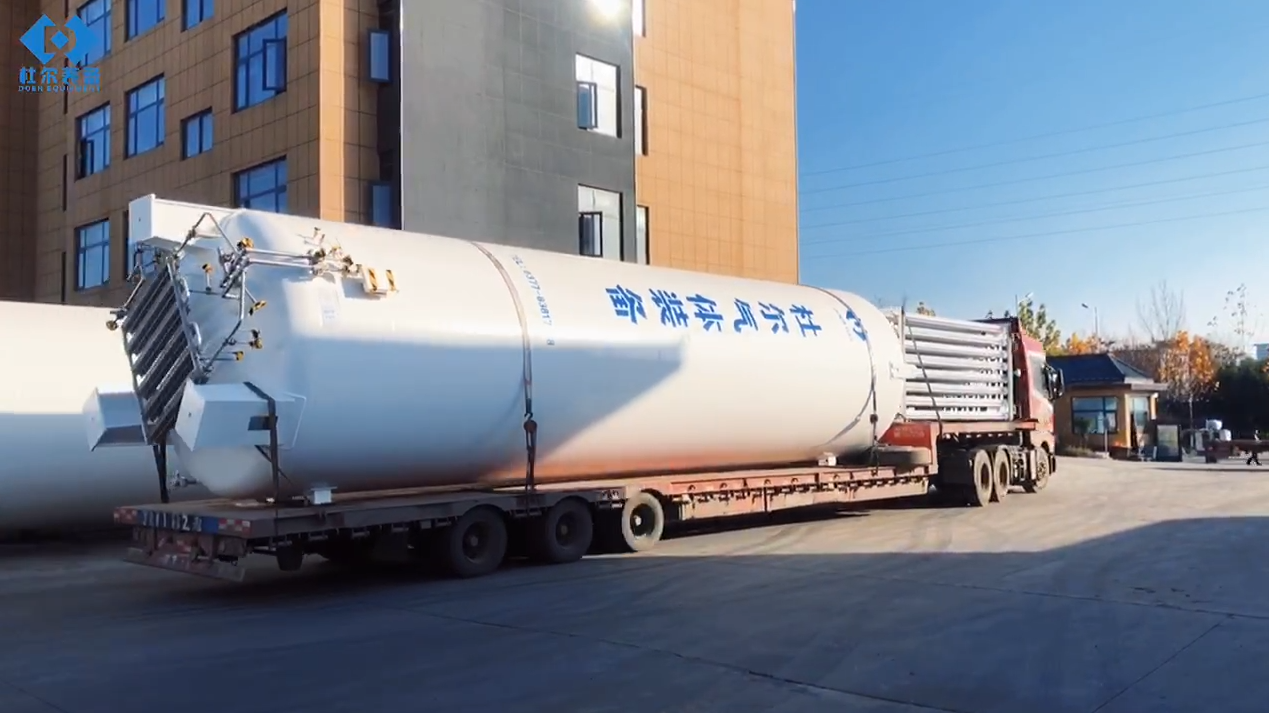
Low-temperature storage tank, Dura gas, pressure vessel
Previous
Next
Previous Page
Next Page
Related
Duer Equipment Lights Up a New Ecosystem for Inland Waterway Shipping with LNG Fuel Tanks
As the philosophy of “Lucid waters and lush mountains are invaluable assets” takes root in the arteries of industry, green shipping is emerging as the core engine driving high-quality development of inland economic belts. Driven strongly by the nation’s policies on new-energy vessels, the market for inland new-energy ships is entering a golden period of rapid growth. On the Xijiang waterway in Guangxi, vessels equipped with LNG fuel tanks supplied by Nanyang Durr Gas Equipment Co., Ltd. are harnessing clean power to paint an ecological picture of “clear waters flowing smoothly.”
2025-11-27
On March 8, 2024, a milestone moment took place in the conference room on the fourth floor of Nanyang Doerr—the launch meeting for the Operations Management System project, co-hosted by Nanyang Doer and Zhongxu Education, was grandly held here. After in-depth interviews and careful preparations in the early stages, both parties have embarked on a new chapter of cooperation.
2024-03-08
The autumn is crisp and refreshing, with the fragrance of golden osmanthus in the air. On September 28, 2022, after intensive preparations, the intelligent production workshop project of the second phase of Nanyang Duer Gas Equipment Co., Ltd. officially entered the construction phase, marking the beginning of a high-tech intelligent production base. On this fertile land, the momentum is grand, and everything indicates a new vitality for the future of this land.
2022-09-28
Mid-Autumn Festival Charity: Deep Respect for the Elderly
On the morning of September 11, 2022, caring individuals from Nanyang visited the Le Ru Jia Elderly Service Center to offer Mid-Autumn Festival greetings.
2022-09-11
Devote love, great love knows no boundaries.
On the afternoon of September 5, 2022, Nanyang Du'er Gas Equipment Co., Ltd. donated to the 99 Charity Day event at the Civil Affairs Bureau of Sheqi County.
2022-09-06

Nanyang Doer Gas Equipment Co., Ltd. is a joint-stock high-tech enterprise. The company is located in the picturesque Han River in the south of Funiu; the source of the South-to-North Water Diversion Project-Nanyang, the place where the militarist Zhuge Liang worked, the famous Qin Chu "The Battle of Danyang" and the Three Kingdoms story "Three-visit the thatched Cottage" took place here...
Contact Us
Company Address:
Economic 1st Road, Industrial Agglomeration Zone, Sheqi County, Nanyang City, Henan Province
Contact Phone:
Company E-mail:
Main Products
Quick Links
Focus on us
All rights reserved©Nanyang Doer Gas Equipment Co., Ltd. has supported ipv6