

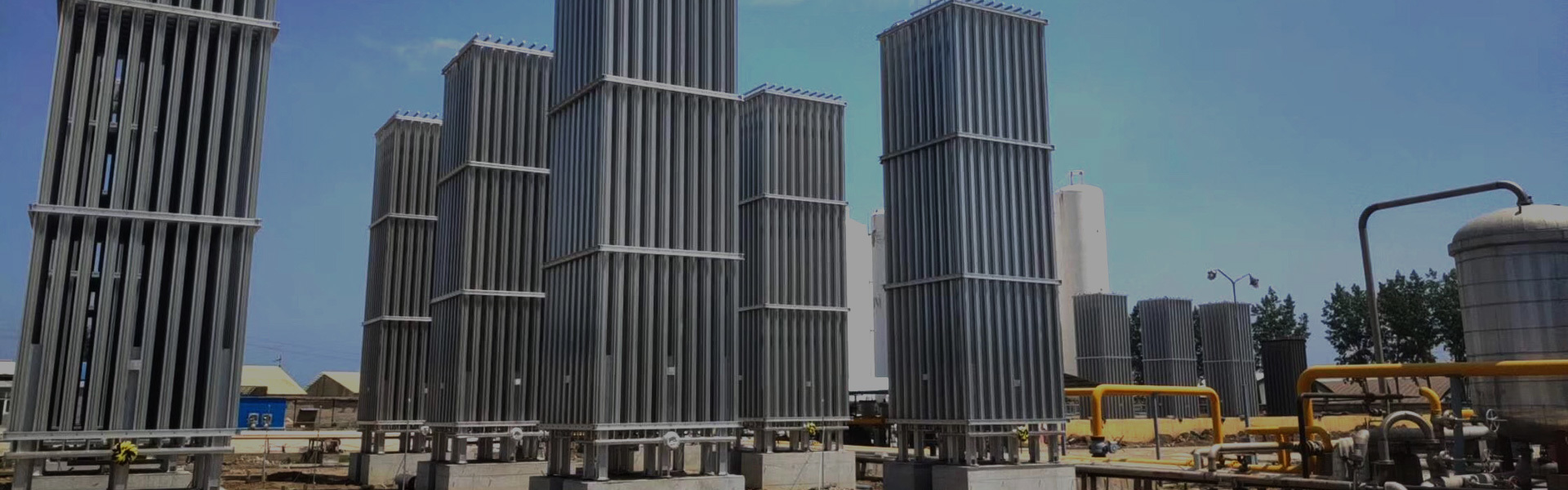

Mother and child canister
Product Details
Mother and Child Tank
The mother and child tank refers to a storage tank consisting of multiple (three or more) content containers (child tanks) arranged in parallel and placed in an outer container (mother tank) filled with insulating material. It is generally designed and constructed to accommodate large volumes and pressurized storage.
Content Container
A pressure vessel used to hold the medium, usually in a vertical cylindrical structure with supporting legs.
Outer Container
A metal shell that houses the content container and forms an annular insulating layer with it, usually in a cylindrical structure with a flat bottom and arched top.
Product Details
Content Container
The design and calculation of the structure, strength, etc. of the content container tank body are carried out according to the relevant provisions of GB150.
The content container does not use vacuum leak detection, so there is no need for external pressure stability design. However, considering that the diameter of the content container is generally large, its rigidity during manufacturing and transportation must be ensured, so the content container still needs to be equipped with reinforcing rings, with a spacing of 2m to 3m.
The content container must be equipped with anti-vortex devices and diffusion plates; reinforcing ribs must be set at the lower head support legs.
The support legs of the content container must adopt insulation design, and the thickness of the epoxy glass cloth board must not be less than 150mm. To ensure the static evaporation rate of the mother and child tank and the space for the interlayer pipeline, the height of the support legs must be sufficient (the height from the lower head of the content container to the ground must not be less than 1500mm).
Cold bridges that cause cold short circuits should be avoided, and insulating gaskets must be set for the connecting bolts of the support legs. Calculations should ensure that the temperature of the outer container's bottom plate does not fall below the minimum temperature that the material of the outer container's bottom plate can withstand.
The seismic design calculations of the content container are carried out according to the relevant provisions of SH3048 'Seismic Design Calculation of Steel Equipment for Petrochemical Industry'. The calculation process does not consider the impact of pipeline connections between content containers and surrounding insulating materials.
Outer Container
The design and calculation of the structure, strength, external pressure stability, etc. of the outer container tank body are carried out according to the relevant provisions of SY/T0608.
The connection between the low-temperature pipeline and the outer container wall adopts a structure of vacuum pipe plus corrugated pipe.
Configuration Parameters
Volume: 300~3000m³
Pressure: 0.3~1.6MPa
Insulation Method: Pearl Sand Accumulation Insulation
Number of Child Tanks: 3, 4, 7, 10, 12
Design, Manufacturing, Acceptance Standards
TSG R0004-2009 'Safety Technical Supervision Regulations for Fixed Pressure Vessels' Volume: 300~3000m³
GB150-1998 'Steel Pressure Vessels'
GB24511-2009 'Stainless Steel Plates and Strips for Pressure Equipment'
GB713-2008 'Steel Plates for Boilers and Pressure Vessels'
GB/T14976-2002 'Seamless Stainless Steel Pipes for Fluid Transport'
GB22724-2008 'Design of Liquefied Natural Gas Equipment and Installation on Land'
GB50183-2004 'Fire Protection Code for Oil and Gas Engineering Design'
GB50084-2001 'Design Code for Automatic Sprinkler Systems'
JB4708-2000 'Welding Procedure Qualification for Steel Pressure Vessels'
JB/T4709-2000 'Welding Code for Steel Pressure Vessels'
JB/T4730-2005 'Non-destructive Testing for Pressure Equipment'
SY/T0608-2006 'Design and Construction of Large Welded Low-pressure Storage Tanks'
SH3408-1999 'Seismic Design Code for Steel Equipment in Petrochemical Industry'
Specification Table

Key words:
Mother and child canister
Related Products



Nanyang Doer Gas Equipment Co., Ltd. is a joint-stock high-tech enterprise. The company is located in the picturesque Han River in the south of Funiu; the source of the South-to-North Water Diversion Project-Nanyang, the place where the militarist Zhuge Liang worked, the famous Qin Chu "The Battle of Danyang" and the Three Kingdoms story "Three-visit the thatched Cottage" took place here...
Contact Us
Company Address:
Economic 1st Road, Industrial Agglomeration Zone, Sheqi County, Nanyang City, Henan Province
Contact Phone:
Company E-mail:
Main Products
Quick Links
Focus on us
All rights reserved©Nanyang Doer Gas Equipment Co., Ltd. has supported ipv6